Balling
The day after hiving our new bees, I checked to see whether they were all drinking from the syrup feeders we had given them. One colony was not drinking from their feeder at all so I decided to make an adjustment. When I took off the feeder, I could see the queen cage, which had been suspended between 2 frames, had fallen onto the bottom board. Worried that this might prevent the workers from feeding the queen, I gently began moving the frames apart.
To my horror, I saw a tight ball of bees not far from the cage aggressively surrounding something. This "balling" behavior allows worker bees to collectively kill an intruder, vibrating their flight muscles to generate heat and increasing the carbon dioxide concentration to both cook and suffocate the offending insect to death. When the worker bees do this to a wasp scout who would otherwise recruit other wasps to attack the honey bee colony, it's a good sign of their defensive abilities. However, sometimes when workers have little experience with a new queen, especially if they are disturbed by a beekeeper, a subset of them will mistake the queen for a dangerous intruder and decide that they must “ball” her.
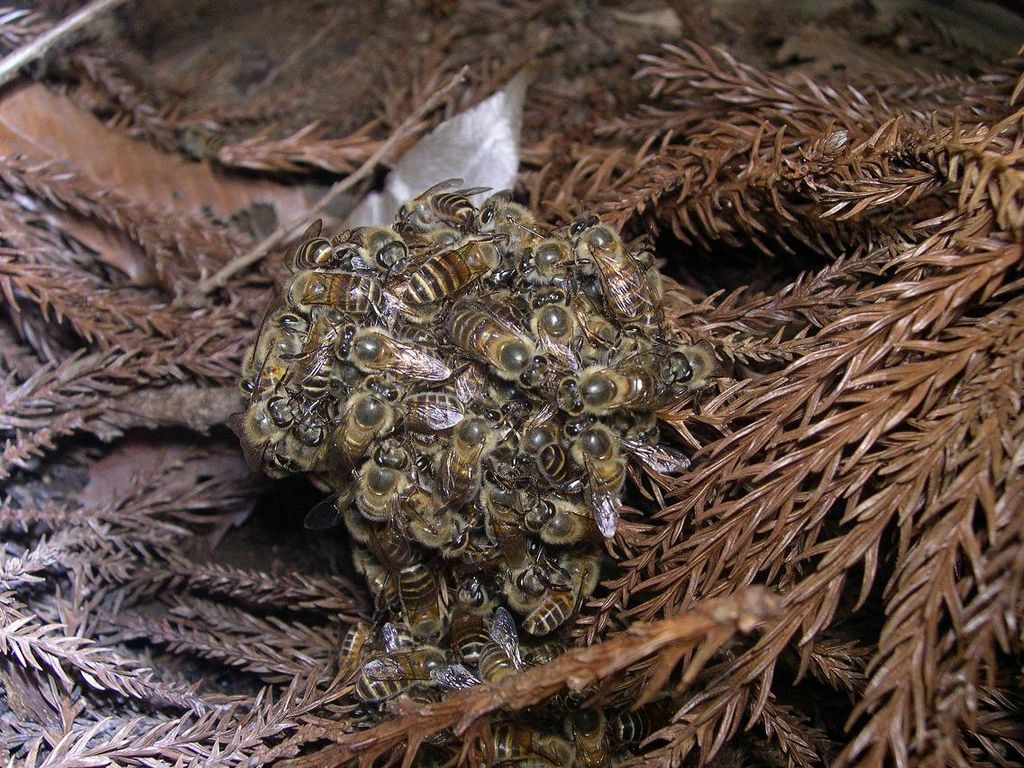
Photo from wikimedia commons: “The Japanese honeybees (Apis cerana japonica) forming a "bee ball" in which two hornets (Vespa simillima xanthoptera) are engulfed and being heated. Yokohama, Kanagawa prefecture, Honshu Island, Japan” by Takahashi [1].
I pulled the queen cage out. Sure enough, they had already eaten through the marshmallow plug and the queen had been released into the hive. With a growing sense of trepidation, I used my hive tool and the handle of a bee brush to disentangle the ball of bees, trying my best not to hurt them but also to stop them from re-forming the ball. Finally, after separating the tightly-linked bees, I spotted the queen's paint dot. Following a bit more maneuvering, she managed to free herself and run away, onto an adjacent frame, a few inches away from most of the workers. If I had brought marshmallows with me, I might have put her back in the cage. As it was, I fervently hoped that the workers had just been temporarily upset by the disturbance I had caused and would soon calm down and accept their new queen. If not, I would need to order another queen, and that would delay the colony’s growth by weeks.
Schrödinger’s queen bee
In Shakespeare’s play, Henry IV: Part II, the king cannot sleep and complains, “uneasy lies the head that wears a crown,” referring to his anxiety about making decisions for a whole kingdom. The word “queen” suggests that a queen honey bee directs all the activities of her colony, a misunderstanding that dates at least as far back as Aristotle, who wrote about his interpretations of honey bee behavior over two thousand years ago (he thought that honey bee societies were governed by a king). In reality, a honey bee queen faces a different sort of uneasiness. She is at the mercy of her workers. Over millions of generations, honey bee queens developed incredibly productive ovaries, but they lost the ability to secrete wax or forage for themselves. A queen’s pheromones, or chemical signals, influence her workers’ behavior and physiology, but the workers collectively decide where to build comb and where to forage for food, when the colony should reproduce by swarming, and where a swarm should build a new home. They decide whether to feed and care for a queen or kill her (usually after raising a new queen to replace her).
While I’m sure that the physicist, Erwin Schrödinger, would cringe if he heard my interpretation of his famous thought experiment, I often think of Schrödinger’s cat when I’m worried about an event that might have occurred but I can’t yet be certain. In that thought experiment, he proposed a hypothetical situation in which a cat is inside of a box with a vial of poison that will only be released and kill the cat if a radioactive substance decays. As I understand it, his point was to wonder: if an atom or a photon can exist in multiple states simultaneously (as the cat could be thought of as both alive and dead until we actually open the box to see), when does it become one or the other? As to that, I have absolutely no idea, and I leave it to the physicists. But I can definitely relate to something being simultaneously in two states at once in my own mind. For example, thinking of the queen I had seen as simultaneously healthy, walking across the comb and dead, her body already removed from the hive by undertaker bees.
Opening the box

Hive with top feeder, cover, and two frames removed [2].
It's recommended to leave newly-hived bees alone for 7-10 days to let them get used to their new space. In that time, they will hopefully build beeswax comb, filling it with syrup/nectar, pollen, and eggs, which makes them invested in that hive and unlikely to abscond (abandon it in search of a better nest site). At the end of a week, I was very anxious to check on the bees, especially the ten queens to make sure that the workers were taking good care of them. We lit a smoker, put on our bee jackets, and opened the first hive. That colony had eaten all of the syrup we gave them, converting much of it into thousands of cells of beeswax comb, concentrated on the center frames within the hive. Worker bees of a certain age have the ability to secrete wax from glands between the plates that form the underside of their abdomens. This wax forms scales that they detach and chew with their mandibles to form the walls of hexagonal beeswax cells. In fact, the colony was so busy creating wax that they had created an extra comb between two frames (beekeepers sometimes call this burr comb) where we had given them too much room. Unfortunately, we had to take that extra comb away from them to make it easier to move the frames.

Beeswax comb produced by one of our colonies. Left photo shows burr comb built between two movable frames [2]. Center photo shows that burr comb after it was removed from the hive [3]. Right photo shows a worker with wax scales coming from glands in her abdomen (see pink arrow) [2].
We removed the queen cage and checked to make sure that the queen had been released. She had. Then we began the search for eggs, tiny, white, rice-shaped structures glued to the foundation at the bottom of the hexagonal cells. These are sure signs that a queen was laying within the last 3 days. It took some shifting of the frames to get the sunlight at the perfect angle for seeing the eggs, but they were definitely there. Hundreds of them. We also saw that the workers had stored much of the syrup in other beeswax cells and were bringing in and storing pollen from flowers, in addition to the pollen substitute patty we had given them. On the third frame, we saw her- the paint-marked queen! Her abdomen had grown to almost twice the length of her wings now that she was actively laying eggs, a good sign the colony would not fly off with their queen any time soon.

Arrows show: Royal blue= queen; purple= egg; orange= new beeswax cell walls; light blue= pollen foragers with tan/yellow pollen loads; green= trophallaxis (food exchange between two workers) [3].
In each colony we saw the same positive signs. Some colonies had more workers than others. Some had more foragers coming home with food. But although they differed, every colony had plenty of comb with stored food and a laying, marked queen- even the colony where the workers had tried to kill their queen just six days before. Thankfully, it seemed that they had come to an understanding. At the last hive, I breathed a sigh of relief.
The only problem we had seen were two pollen substitute patties where small hive beetles, a pest that stresses but seldom kills honey bee colonies, had laid their eggs. Those eggs had hatched into little larvae, crawling around and eating the highly nutritious patties- like tiny white caterpillars with red heads and little, red, spike-like hairs along their bodies. We removed these patties and the larvae so that they wouldn't bother our bees.

Hive beetle larvae eating a pollen substitute patty [2]. The larvae grow as they get older and molt, shedding their old exoskeletons, multiple times before reaching full size. Then they pupate in the soil and become adult beetles that can fly to other hives.
It is remarkable how much new honey bee colonies can develop in a single week. The younger workers had quickly set about building the comb, storing food, cleaning the hive, and feeding the first tiny larvae. The older workers had set off to find the most rewarding patches of flowers in the landscape around them, bringing back nectar and multiple colors of pollen. Already we saw returning foragers launch into figure-eight waggle dances. The middle phases of those dances, when the dancer walks in a straight line and waggles her abdomen back and forth, indicate which direction and how far to fly to find the flowers. We could see other foragers following these dances, paying attention to the directions so that they too could collect food from the same patch of flowers. In a week, we hope to start video recording similar dances in glass walled observation hives at the Bernard Field Station. Happily, it looks like our bees are more than up to the task!
Further Reading
Yong, E. “Bees kill hornets with carbon dioxide emissions and local warming.” Discover, July 5, 2009.
Moore, P.A., Wilson, M.E., Skinner, J.A. (2015) Honey bee queens: Evaluating the most important colony member. Bee Health, 7(10). https://bee-health.extension.org/honey-bee-queens-evaluating-the-most-important-colony-member/.
Media Credits
[1]: Photo by Takahashi, Creative Commons Attribution-Share Alike 2.1 Japan

[2]: Photos by Morgan Carr-Markell
[3]: Photos by Matina Donaldson-Matasci