In the winter, looking for an opportunity to do research, I came across the Bee Lab blog, where I noticed an article about the strategic behavior of turtle ants. Reading about their specialized shapes and tactical positioning immediately reminded me of chess and the different role each piece plays on the board.
Like all tree-dwelling animals, turtle ants (Cephalotes) face serious competition for relatively few available nesting sites. The solution the turtle ants have devised involves a high degree of social organization and what biologists call "morphological specialization": within every species, there are differently-shaped sub-classes of ant, each with a different set of strengths ideal for a subset of the diverse list of tasks necessary to run a colony. One thing that makes turtle ants interesting is their distinct soldier class, built specially for defending the narrow entrances to the cavities created by tunneling beetles in which they make their homes. There are several subclasses that fall under the 'soldier' umbrella, but they all have one feature in common: a round, flat head significantly wider than their bodies.
 |
| [1] Even within the same species, the Cephalotes texanus worker and soldier ants (left to right) have greatly varying head shapes and sizes. |
Rise of the Door Head
How did such an oddly-shaped creature come about? Scott Powell, a biologist at George Washington University (and a collaborator!), has led several studies investigating the evolution of turtle ants. In 2008, he released a paper concluding that the turtle ant's choice of habitat - leftover beetle-larvae tunnels roughly the diameter of an ant - caused the emergence of a soldier class especially well-suited to positional defense. Once again, evolution converges to a solutionover time, right? Within the genus Cephalotes, the roughly 130 species each appear to have one of four archetypes of soldier ants, each with a slightly differently shaped head. Some heads are flat and exactly tunnel-sized, perfect for blocking an entrance alone, while others are squarer and are better suited to being part of a group shield wall. Intuitively, this would suggest that when turtle ants first emerged, they wouldn't have had any special classes or head shapes, and specialization would have caused odd head shapes to arise over time.
 |
| [2] The head of a Cephalotes varians soldier, serving its purpose as a tunnel door |
It turns out that the real answer is probably far more complex. A new study by Powell's research team uses genetic information from 89 species of turtle ants to infer how they might have evolved and specialized. Among other findings, the study suggests that their common ancestor had only a general-purpose worker class that had more in common with the square-headed soldier ants than with the less-protected worker ants that exist in each Cephalotes species today. This information appears to show that different populations specialized not only by evolving forward but also by reversing the direction of evolution, 'rolling back' changes that had previously occurred. Over time, one ant species diverged into many, specializing to fill many different environmental niches. The authors explain that head size and shape evolution is "extensively reversible [...] and repeatable". Across the board, soldier and queen head size were strongly correlated, but the morphological differences between other castes was essentially unrelated to either. These findings demonstrate that even within a species, morphological specialization is a dynamic endeavor that is far more complex than linear progress towards an optimally-shaped ant.
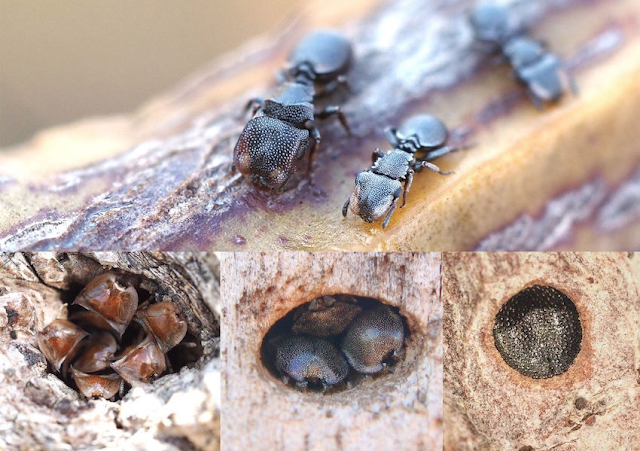 |
| [3] The highly specialized head shapes of different soldiers |
Conclusion
It'd be much harder to win a game of chess without the synergy of the different pieces, each fulfilling a different tactical niche on the board. In the same way, turtle ants benefit greatly from their specialized soldier and worker classes, which arose over time to broaden the choice of defensible homes in which to nest. Interestingly, Cephalotes specialization is far from linear. This highly complex process, which biologists call a product of "divergent pulses of change", puts nature's amazing capacity to adapt and solve problems on full display.
Further Reading:
- Sokol, Joshua. 2015. "Ants use their flattened heads as doors to lock down their nests." The New Scientist: Zoologger. November 11, 2015. https://www.newscientist.com/article/dn28481-zoologger-ants-that-use-their-heads-to-lock-down-their-nests/
- Powell, Scott, Price, Shauna L., Kronauer, Daniel J. C. 2020. "Trait evolution is reversible, repeatable, and decoupled in the soldier caste of turtle ants." Proceedings of the National Academy of Sciences USA, 117 (March): 6608-6615. doi.org/10.1073/pnas.1913750117
- Powell, Scott. 2008. "Ecological specialization and the evolution of a specialized caste in Cephalotes ants." Functional Ecology 22 (October): 902-911. doi.org/10.1111/j.1365-2435.2008.01436.x
- Powell, Scott, Donaldson-Matasci, Matina, Woodrow‐Tomizuka, Augustus and Dornhaus, Anna. 2017. "Context‐dependent defences in turtle ants: Resource defensibility and threat level induce dynamic shifts in soldier deployment." Functional Ecology 31 (December): 2287-2298. doi.org/10.1111/1365-2435.12926
Media credits:
[1] Photo by Alexander Wild. https://www.alexanderwild.com/Ants/Taxonomic-List-of-Ant-Genera/Cephalotes/i-j994v4Q/A
[2] Photo by Alexander Wild. https://www.alexanderwild.com/Ants/Taxonomic-List-of-Ant-Genera/Cephalotes/i-2xJ7DGM/A
[3] Photo by Scott Powell. https://www.rockefeller.edu/news/27713-turtle-ant-soldiers-heads-evolution/
No comments:
Post a Comment