Have you ever watched a WWE wrestling match and wished you could see it at a fraction of the size? Ever wanted to see miniature body slams, tiny submission holds and even small aerial moves? Well, for the past couple weeks in the Bee Lab, this mini fight club dream has been realised in the form of Ant Aggression videos. These videos are one part of Marissa’s thesis project, and a trailer for her final presentation and results can be found here. In each video, a Cephalotes varians (Turtle Ant) and a Pseudomyrmex gracilis (Twig Ants) are pitted against each other in a Petri dish for a five minute matchup (no holds barred!!).
The Turtle Ants are short, squat, and, similar to turtles, able to protect themselves with a tough outer body. They are the ‘native’ species in our lab. The Twig Ants’ abilities lean more towards the offensive; they are larger and leaner than the Turtle Ants, and have the ability to sting and bite. They are the ‘invasive’ species in our lab. Both species were collected from Florida, and prefer to live in trees, within twigs that have small, easily defensible holes. Because Twig and Turtle Ants live in the same habitat, their colonies must compete with each other when placed in the same region with limited space. Further introduction of our wrestlemania opponents can be found in Chloé’s blog post: Floridian Ants: The true test of my patience.
It is my lab partner, Hanna, and my job to watch these videos and record a score for the level of aggression shown by each ant. The first “level” that we keep track of in these videos does NOT contribute to the overall aggression score, because these level 1 actions are when the ants are actively avoiding one another. The three levels and actions which DO contribute to the overall score are: non contact actions within level 2, brief contact actions within level 3, and prolonged contact actions within level 4. Some matches are brutal, while others are quite snooze-worthy, and in this blog post I will provide examples of each level of aggression and how they are scored (complete with some pro-wrestling moves demonstrated by our ants!).
For each video, the Turtle Ant and the Twig Ant each receive an overall avoidance score, which is the amount of times each ant actively avoids contact (this is just the number of level 1 actions). Each time a Turtle Ant or a Twig Ant runs away from the other in the Petri dish, we increase the active avoidance interaction score by one for that ant. As you can see in Series 1, there isn’t much room for our mini opponents to run from each other in the ring, and often they are forced to confront each other again after circling back around. In some of the videos we analyzed, both opponents chose to posture at each other instead of attack, and most of the actions were tallied as level 1 aggression.
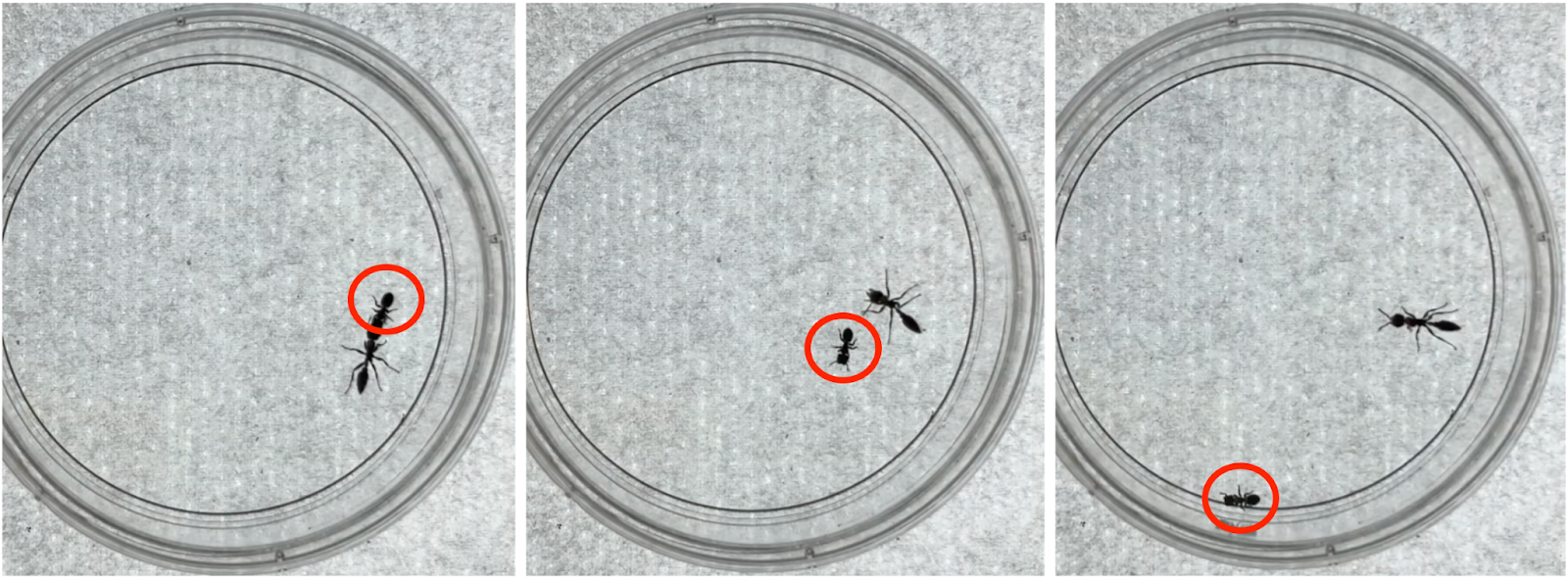
Series 1: Here is a Turtle Ant (circled in red) in the process of running from a Twig Ant after a bite, throughout multiple frames of a video.
Now onto the three levels of actions which contribute to the overall aggression scores we give each ant: level 2 (non-contact), level 3 (brief contact), and level 4 (prolonged contact). First, we start with non-contact actions, which contribute 1 point to the overall aggression score of that ant. Unlike human WWE wrestlers, ants cannot trash talk their opponents, so what do non-contact threats from ants look like? Both the Turtle Ants and Twig Ants can antennate (wiggle their antennae threateningly) at each other. So far, only the Twig Ants seem to scent-mark (which is used to mark their territory and warn other ants) by rubbing the ground with their abdomen; Twig Ants have also been the only ones to rub their legs on their abdomen. The Turtle Ants have yet to display these pro-moves, but many are so flat that it is hard to pick up on video (unfortunate for the fans at home who don’t want to miss any of the action). Picture 2 and 3 show freeze frames of examples of non-contact threats.

Picture 2: Here is a Twig Ant rubbing its leg on its abdomen.

Picture 3: Here is a Turtle Ant and a Twig Ant antennating at each other.
Next, we record the amount of brief contacts (level 3) that happen between the ants. When one ant chases after the other, or there is a quick bite, we contribute 2 points to that ant’s overall aggression score. Both species of ants can chase each other, however the Twig Ant is the only one of the two who has been observed to bite. This powerful move certainly makes for an entertaining match! Despite the Twig Ant having this offensive advantage, the Turtle Ant is a master of defense; it is able to withstand attacks using its hard shell and tucking its antennae in. Picture 4 contains an example of a Twig Ant post-attack, and the Turtle Ant still curled up in defensive position. If a Twig Ant is particularly violent, these level 3 acts of aggression can be almost non-stop, with one video recording around 30 quick bites.

Picture 4: Here is a Twig Ant right after a quick bite, and the Turtle Ant still recovering.
And last but not least, what fans of WWE have been waiting for…. (drum roll please)...LEVEL 4 AGGRESSION!! These are the aggression tallies that bring us the entertainment, the drama, the adrenaline! The actions which add 3 points to the overall aggression score each time an ant commits them are: biting and holding, and permanent injury. In the videos we’ve watched, biting and holding is better described as biting and body-slamming (similar to the aptly named “spinebuster” move in pro-wrestling). There is an example of this in Series 2, where the Twig Ant is using its bite-hold to throw the Turtle Ant on its back. In some videos, a Twig Ant is able to fling the Turtle Ant clear across the Petri dish. These aerial stunts and ruthless tosses lead to very high overall aggression scores. While there weren’t any permanent injuries in our videos, an example of one would be a leg being ripped off of one of the ants.

Series 2: Here is a Twig Ant biting and holding a Turtle Ant, and then throwing the Turtle Ant to the ground.
As a recap, the level 1 actions (running away) do not contribute to the overall aggression score of each ant, while levels 2, 3, and 4 aggression acts are weighted and then summed to create the overall aggression score. Scoring these videos not only provides small WWE-style entertainment for me and my lab partners, but the overall aggression scores obtained from them for the P. gracilis and Turtle Ants are essential for understanding the behavior and interactions of these two species. While very few casualties resulted from our ant matchups (only one Turtle Ant succumbed to injury), these confrontations between the two species helps us to study the response of a native species (Turtle Ant) to the presence of an invasive species (Twig Ant). So, the next time that you see human WWE, think of the tiny, six-legged gladiators duking it out in the name of scientific discovery.
Further Reading:
Chloé Andrieux-Amadeï. “Floridian Ants: The true test of my patience”, HMC Bee Lab, Harvey Mudd College, 26 Dec. 2024,
https://hmcbee.blogspot.com/2024/12/floridian-ants-true-test-of-my-patience.html
K.G. Human, Deborah M. Gordon. “Behavioral interactions of the invasive Argentine ant with native ant species”, Department of Biological Sciences, Stanford University, 20 Jun. 2019,
https://web.stanford.edu/~dmgordon/old2/Gordon1999Behavioral.pdf
Marissa Douglas. “Thesis Trailer for interspecific competition of Cephalotes varians and Pseudomyrmex gracilis”, HMC Bee Lab, Harvey Mudd College, 24 Mar. 2025,
https://www.youtube.com/watch?v=MtBHG3XNVxY
No comments:
Post a Comment