"If the Bee Disappeared Off the Face of the Earth,
Man Would Only Have Four Years Left To Live"
Maurice Maeterlinck, The Life of the Bee
Let’s answer the age-old question: is it always better to be bigger?
For many animals, there are several advantages to being bigger: bigger creatures tend to live longer, travel farther, are less likely to be eaten by other animals, and are better adapted to colder habitats. However, there are also distinct disadvantages to being big; After all, the dinosaurs did go extinct, while rodents survived.
Which of these is the case for bees? Well, we might think that all bees are small, but bee sizes can actually vary greatly between different species -- from giants with 2.5 inch wingspans, to individuals less than 2 mm long. In the middle of the size range are two of the most important pollinators for humans: bumblebees and honey bees, respectively around 6-25 mm and 15 mm. Bumblebees and honey bees live in colonies. Bumblebee colonies have 50-400 individuals, while honey bee colonies have up to tens of thousands of individuals.
If bees have enough food resources, it turns out that the bigger the bee, the better. Being pollinators, their diet consists of nectar and pollen. Foraging bees bring back resources of nectar and pollen to the colony, and bigger bees carry more resources per trip. Bumblebee colonies that have larger individuals on average have been shown to do better as a whole, compared to colonies with smaller bees.
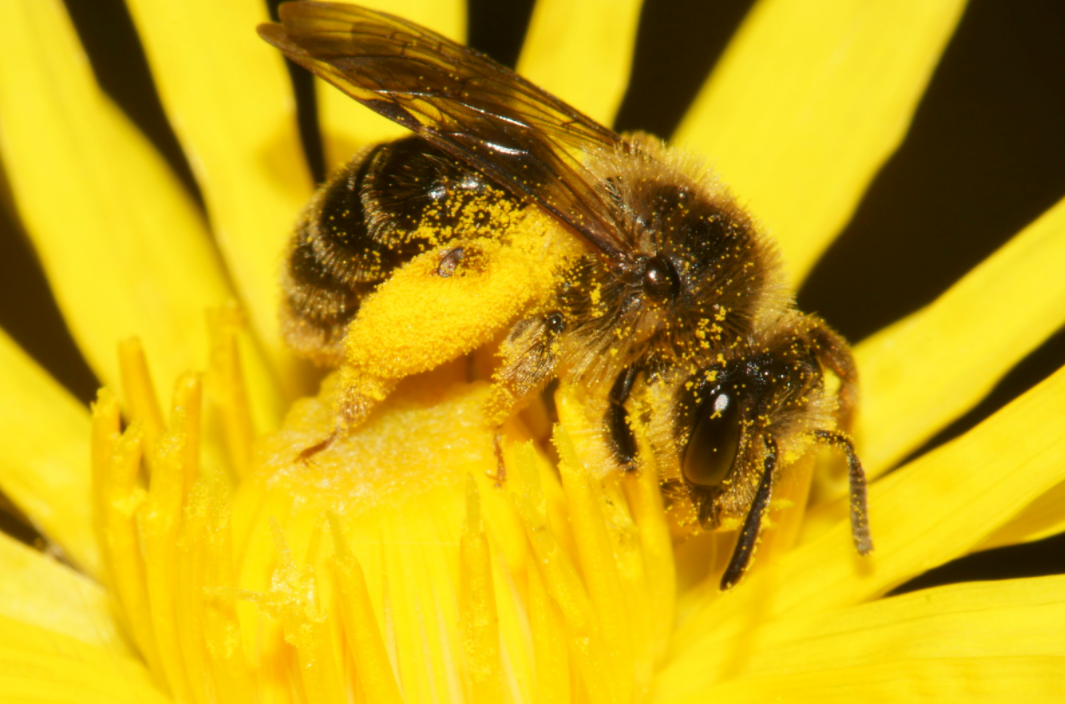
[1] A bee collecting pollen from hawkweed.
Not only are bigger bees able to carry more resources, they’re able to travel farther as well. No matter how you measure bee size -- whether that be head width, body length, wingspan, or an estimation of body mass -- bigger species travel farther for resources than smaller bee species. (Of course, size isn’t the only indicator of how far a bee may travel to forage. For example, honey bees forage farther than expected given their body size, possibly due to their communication through their waggle dance).
We’ve all heard that bees are going extinct. But a recent study of bees in New Hampshire found that not only are individual species of bumblebees getting smaller, the bigger bee species are declining in numbers faster than smaller bee species. In other words, bees are getting smaller on average. Other studies have shown and supported that bigger bees are experiencing a reduction in body size much more significantly than smaller bees. The reduction in body size is most apparent at low elevations, where there’s more forest and agriculture.
What does this mean for the forests and agriculture? If we believe that 1) bees perform better when bigger and 2) bees near forests and agriculture are declining in size, then the future of pollination in forests and agriculture may decline faster than we originally thought. Even if bees don’t completely go extinct, smaller bees may pollinate less effectively, so a decrease in their body size still could be detrimental to crops and wild plants. The decrease in body size is likely due to a combination of global warming, habitat loss, decline in food sources, and pesticides. In any case, closer studies of bee body sizes may help us better understand how to save the bees.
Further Readings:
Herrmann, John D., et al. “Mean Body Size Predicts Colony Performance in the Common Eastern Bumble Bee (Bombus Impatiens).” Ecological Entomology, vol. 43, no. 4, 2018, pp. 458–462., doi:10.1111/een.12517.
Greenleaf, Sarah S., et al. “Bee Foraging Ranges and Their Relationship to Body Size.” Oecologia, vol. 153, no. 3, pp 589-596., doi:10.1007/s00442-007-0752-9.
Nooten, Sabine S., and Sandra M. Rehan. “Historical Changes in Bumble Bee Body Size and Range Shift of Declining Species.” Biodiversity and Conservation, vol. 29, no. 2, 2019, pp. 451–467., doi:10.1007/s10531-019-01893-7.
Ratnieks, F. L., & Shackleton, K. (2015). Does the waggle dance help honey bees to forage at greater distances than expected for their body size? Frontiers in Ecology and Evolution, 3. doi:10.3389/fevo.2015.00031
Media:
[1] Photo by bramblejungle on flickr: https://flic.kr/p/ujYyAQ
No comments:
Post a Comment