Since we mostly see ants running around on the ground, you might think ants only live and build their homes underground. However, that is not true. Some ants are actually able to make trees their playgrounds and build up colonies with shockingly complex structures without ever setting foot on the ground. The HMC Bee Lab became particularly interested in the behaviour of one such species of arboreal ant called turtle ants (scientific name Cephalotes varians). In order to learn more about this cute little creature and prepare for future lab experiments on it, we went to the Florida Keys to collect turtle ants and learn about their habitats.
The first problem we needed to tackle, of course, was to locate the turtle ants. Our cute turtle ants are nocturnal and build their colonies inside the cavities of the dead branches. This made it really hard for us to find them in the day-time without ruining their homes by breaking dead branches. As an ant expert, Dr. Scott from George Washington University had a lot of experience interacting with and collecting turtle ants, and he taught us an ingenious way to locate them. Because ants, especially turtle ants, usually need nitrogen, human urine can be used to trap ants and work as an indicator of whether our ants exist in specific trees. With traps made with urine and dish detergent, we successfully located three areas where we might be able to find turtle ant colonies.
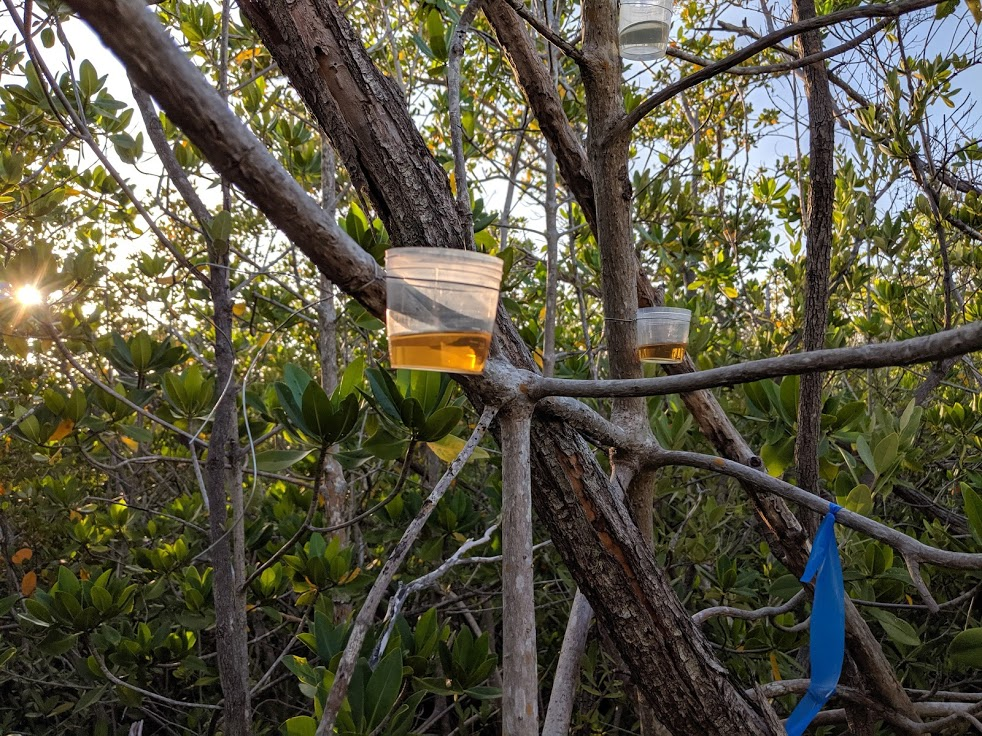

Left: Traps made with urine and detergent in plastic cups tangled on branches with metal wires [1]
Right: Many ants trapped in our delicate trap. In this specific trap, we mainly captured Camponotus a.k.a. carpenter ants, which weren’t the type of ants we were looking for. [2]
After locating turtle ants, we needed to collect their colonies to prepare for our lab research. Turtle ants live in cavities in dead branches on red mangroves and poisonwoods, a relative of poison ivy. So to find our precious little turtle ants, we had to break so many twigs on different trees (Sorry trees😭). Once we found a dead branch with turtle ants in it, we needed to systematically break every dead branch on that tree (Sorry trees again😭). Many trees we looked at only contained one or two turtle ant nests but also contained nests of many other kinds of ants. But since turtle ants are the divas of our research, we had to abandon colonies of other ants (Sorry ants😭).

Carol (GWU), Jarred (HMC), and Tom (HMC) observing a twig with turtle ants in it [3]
An interesting thing to learn when trying to find turtle ants was to differentiate them from other ant species. When looking into the twigs, we could see mainly three kinds of ants. The two kinds of ants that we saw most often belonged to the genus Pseudomyrmex [4]. They were fast little creatures that occupied most of the trees we examined. Some kinds of Pseudomyrmex, especially the type nicknamed slender twig ants (scientific name P. gracilis), can occupy the same type of cavities as turtle ants. Another kind of ant we saw sometimes were sesame-sized, golden, crystal-like ants. These ants are both super-cute and super successful in building their homes in the competitive Florida hammock forest ecosystem. The main character of our research, the turtle ants, are fat and slow-ish little black creatures of medium size [5]. Since turtle ants are slower, they did not usually run away quickly when we broke their branches like Pseudomyrmex and the golden ants. That became a useful way for us to tell whether we found the right ants.


Left: Pseudomyrmex [4]. Right: Cephalotes varians [5]
In addition to collecting them, we also looked at turtle ants’ transportation networks, or the system of nests and paths between nests along which turtle ants transport their food and brood. After measuring distances between nodes (junctions of different branches) and nests, we were able to digitise and visualise the ant networks (see image [6]). We also tried using 3D modelling with the software AgiSoft Photoscan to characterize the branching structure of the tree. We hope that by studying their colony structures, we can understand how ants manage to transport food and brood efficiently from place to place, while minimising the energy and material costs in maintaining the transport network and ensuring that the network can still work even when it undergoes damage.

The ant network constructed with tree nodes (blue) and turtle ant nests (yellow) digitised by Valentin Lecheval (York University). [6]

The team kayaking into the red mangrove forest looking for turtle ants [7]
The early summer in Florida was already hot and humid. We spent days after days under the burning sun looking for our cute little turtle ants, but our excitement never burned down. Going back home with our precious collection of turtle ants, we can’t wait to study how these ants build their networks of nests and how they behave in response to different environmental pressures.

Turtle ant colonies brought back to the HMC Bee Lab [8]
Further Reading:
James K. Wetterer, 2016. “Geographic distribution of Cephalotes varians (Hymenoptera: Formicidae).” 2016, Florida Entomologist: Volume 99, No. 4. www.bioone.org/doi/pdf/10.1653/024.099.0429.
Zoe Cook, Daniel W. Franks, Elva J. H. Robinson, 2014. “Efficiency and robustness of ant colony transportation networks.” Behavioral ecology and sociobiology. https://link.springer.com/article/10.1007/s00265-013-1665-8.
Media Credits:
[1] Traps made by urine and detergents in plastic cups tangled on branches with metal wires, taken by Prof. Donaldson.
[2] Many ants trapped in our delicate trap. In this specific trap, we mainly captured Camponotus aka carpenter ants, which wasn’t the type of ants we were looking for, taken by Prof. Donaldson.
[3] Carol (GWU), Jarred (HMC), and Tom (HMC) observing twigs with turtle ants in it, taken by Prof. Donaldson.
[4] Pseudomyrmex gracilis (a twig ant) by Ted MacRae, https://www.flickr.com/photos/49679700@N07/5580122395
[5] Cephalotes varians by Alexander Wild, https://www.alexanderwild.com/Ants/Taxonomic-List-of-Ant-Genera/Cephalotes/i-PfqGtQQ/A
[6] The ant network constructed with tree nodes (blue) and turtle ant nests (yellow) digitised by Valentin Lecheval (York University).
[7] The team kayaking into the red mangrove forest looking for turtle ants, taken by Prof. Donaldson.
[8] Turtle ant colonies brought back to the HMC Bee Lab, taken by Tom Fu.
No comments:
Post a Comment