Imagine the following scenario as a kid:
Your parents are out of town and they left you and your sibling a meal in the fridge for dinner. As dinner time approaches, you find yourself getting hungry, and upon opening the fridge door, you see that your mom left you her famous mac and cheese. While you know the right thing to do would be splitting it evenly, you find it harder to stop yourself with every single bite. At this point, you could be reasonable and ask your sibling if you could have some extra, or just eat it all before they even find out and bear the consequences.
Even though the latter seems like an unlikely choice to make, it also does not seem impossible, given that children are not always the best at making judgments and communicating themselves. The task of eating food from a limited resource without adult supervision may not be a problem that children tackle every day, but it is an essential part of survival for a wide variety of animals with parental care. In nature, the amount of food provided by the parent, and how it is shared among siblings can play a major role in deciding which individuals will survive. This phenomenon, which can also be called sibling competition, has led to the development of different strategies among species and individuals, most of which have selfish motivations and maximize personal survival (or alternatively, maximize intake of mac and cheese). However, some organisms have developed altruistic behaviors that reduce competition and also help the survival of their kin.
One such intriguing altruistic behavior has recently been observed in a study[i] on barn owl (Tyto alba) nestlings. Barn owls forage at night, so the parent will deliver all the food that its offspring need to the nest within the first few hours of the night, preparing a food stock which the owlets can slowly go through for the rest of the night and day. Additionally, the parent will leave the nest during the day, leaving the owlets to negotiate over the food on their own. While the owlets could just physically fight over the resources, their highly vocal and non-violent nature[ii] has given rise to negotiation via vocal communication instead. The study that was conducted by Dreiss et al. found that owlets avoid eating when they hear the hissing calls -- which are known to honestly reflect hunger levels, as hungrier individuals will call for longer and more frequently[iii] -- of their siblings, allowing the hungry owlet to eat from the food available within the nest without any interference or physical competition.
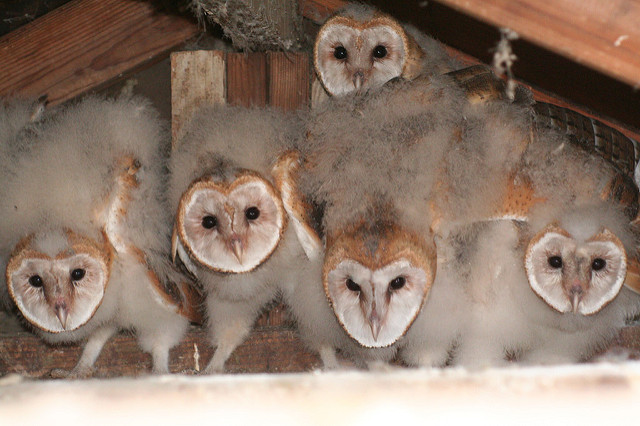 |
| A parliament of barn owls found nesting in a roof |
This is the first time that young animals have been observed using communication to announce ownership over food which is visible and easily accessible (while it has been observed in adult primates[iv] and birds[v].) Given that even children have a hard time sharing food with their siblings, it is fascinating that these owlets have developed a method of communication to resolve conflicts at such a young age. While children do not require such a method of communication because most of their eating necessities are cared for by their parents, having a similar mechanism in children would decrease the number of food-related fights that siblings get into and make lives of parents slightly easier.
References:
[i] Dreiss, Amélie N., Florence Gaime, Alice Delarbre, Letizia Moroni, Mélissa Lenarth, and Alexandre Roulin. “Vocal Communication Regulates Sibling Competition over Food Stock.” Behavioral Ecology and Sociobiology 70, no. 6 (April 12, 2016): 927–37. doi:10.1007/s00265-016-2114-2.
[ii] Cramp S, Simmons KEL (1985) ”The birds of Europe, the Middle-east and North Africa. The birds of Western Paleartic, vol 4. Terns to Woodpeckers”. Oxford University Press, Oxford
[iii] Ruppli, Charlène A., Amélie N. Dreiss, and Alexandre Roulin. “Efficiency and Significance of Multiple Vocal Signals in Sibling Competition.” Evolutionary Biology 40, no. 4 (April 24, 2013): 579–88. doi:10.1007/s11692-013-9233-8.
[iv] Gros-Louis, Julie. “The Function of Food-Associated Calls in White-Faced Capuchin Monkeys, Cebus Capucinus, from the Perspective of the Signaller.” Animal Behaviour 67, no. 3 (March 2004): 431–40. doi:10.1016/j.anbehav.2003.04.009.
[v] Radford, Andrew N., and Amanda R. Ridley. “Close Calling Regulates Spacing between Foraging Competitors in the Group-Living Pied Babbler.” Animal Behaviour 75, no. 2 (February 2008): 519–27. doi:10.1016/j.anbehav.2007.05.016.
Image Credit:
“Owlets” by 5thLargestinAfrica, is licensed under CC BY 2.0. https://www.flickr.com/photos/chdwckvnstrsslhm/140177600
Just thinking about how this system was selected for and the balance between increasing individual fitness versus increase fitness of siblings, do we think there is potentially a point of diminishing returns to an individual owlet's fitness with eating more? That is to say, that there is no fitness benefit to eating more than a certain threshold amount? Considering that the owlets eat the same total amount of food overnight (they just do it sooner or later based on the condition of their siblings), maybe this system doesn't involve that much of a sacrifice for those individuals that eat later (since they still eat the same amount) but just greatly benefits the very hungry individuals that eat first.
ReplyDelete