 |
| Non-native mustard plant, Bernard Field Station |
For the past
three weeks, I have gone to the Bernard Field Station (BFS) in Claremont, CA a few times to collect
data on the density of mustard plants along trails. I am collecting this data to get a better understanding of the
prevalence of both the mustard plants native to the BFS compared to those that are considered exotic, or non-native. The native mustards are welcomed
tenants to the field station’s ecosystems. Whenever there is a botanical block
party at the field station, we can count on the native mustards bringing some
kind of pie or an interesting kimchi or bok choy dish. On the other hand, the
non-native mustards are more like Vince Vaughn and Owen Wilson in their
thespian prime: wedding crashers.
Every other Saturday, a
group of volunteers walk along the main trails of the Bernard Field Station
removing invasive plant species. This group primarily targets the Sahara
mustard (Brassica tournefortii). I
imagine the Sahara mustard probably feels like the student who has a long
history of being talkative and disruptive, so as soon as that student starts to
speak out of place, the teacher is quick to quiet that student without much
discretion. So why single out the Sahara mustard? Well, look at this pair of images from the Arizona-Sonora Desert Museum’s website.
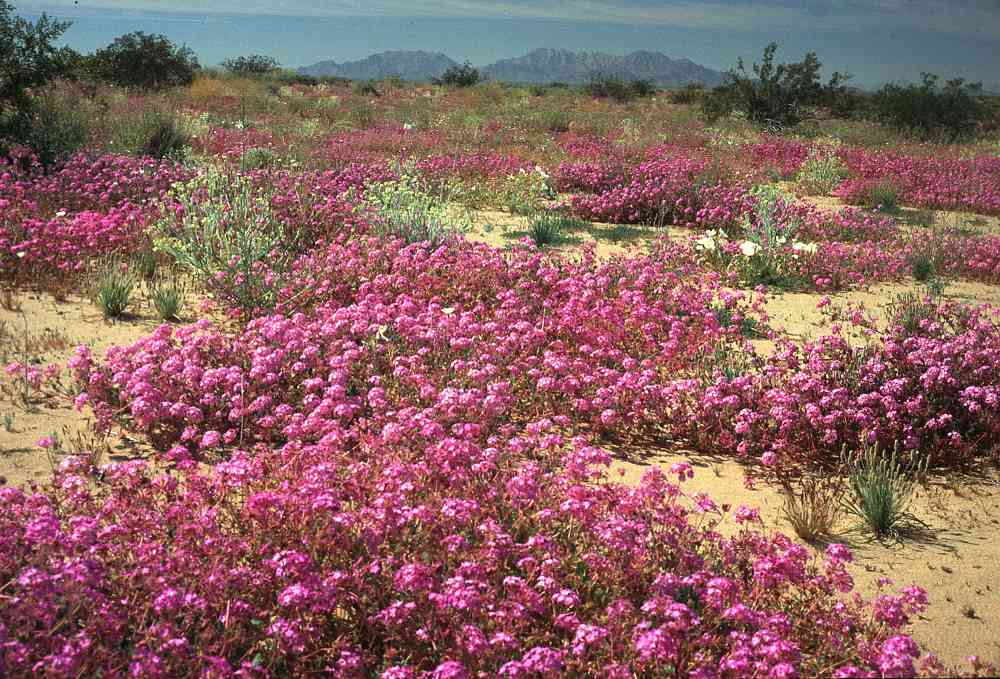 |
| Mohawk Dunes, Arizona in 1998 |
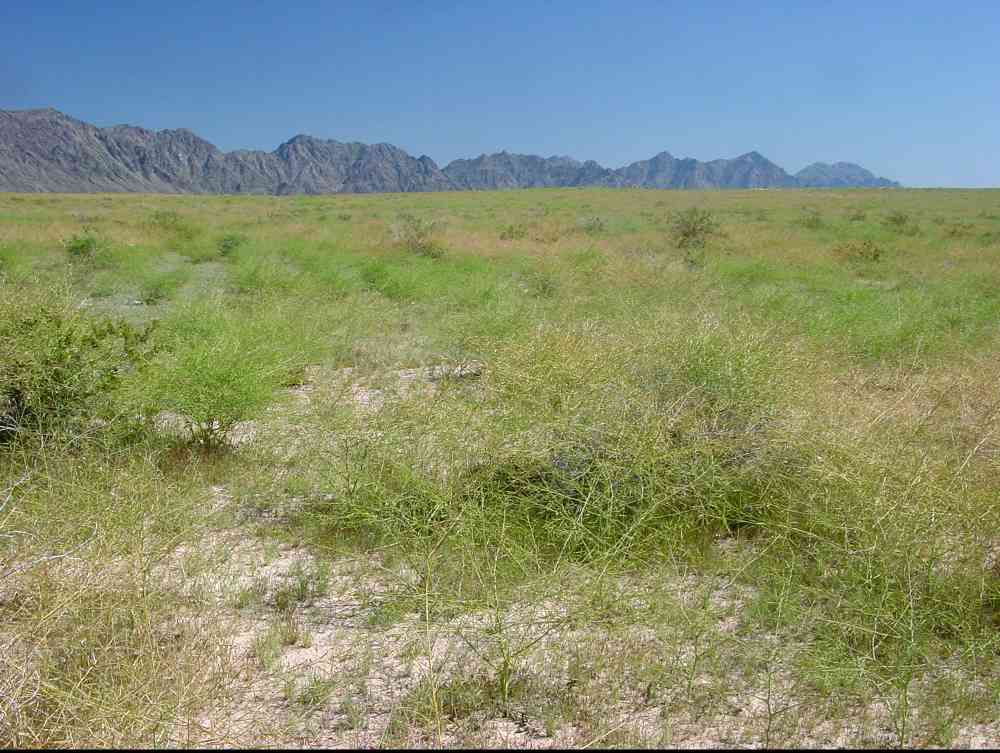 |
| Mohawk Dunes, Arizona in 2005 |
The first photo is an image of the
northern end of the Mohawk Dunes of western Arizona in 1998, while
the second photo is ostensibly the same area of the northern end of the
Mohawk Dunes of western Arizona, but in 2005, after the introduction of Brassica tournefortii.
The Sahara mustard is a champion amongst invasive species. The Sahara mustard
is native to the Sahara region of North Africa, so they are built to thrive in
the most arid conditions. These winter annuals rapidly grow to maturity with a
tiniest amount of water, similar to a Prius getting phenomenal MPG on a quarter
tank of gas. The Sahara mustard is also known to have ground-intrusive,
far-reaching roots, allowing the plant to better take advantage of low moisture
areas at the expense of neighboring plants also depending on the presence
groundwater. Their lateral growth creates an organic canopy, shading small
plants from light crucial to their growth. Old and dried Sahara mustards are
like Hector Salamanca,
somehow finding ways to continue to wreak havoc on the landscape by breaking
off at the base to tumble in the wind, further spreading Sahara mustard seeds
across the area. Needless to say, the Sahara mustard can become quite
troublesome if left to its own device, and must be sought out for extirpation
regularly.
However, there are
other varieties of non-native mustards that the volunteers often leave to grow,
as they pose less of an invasive threat compared to the Sahara mustard. Volunteers
of the Bernard Field Station postulate that the presence of non-native mustard
plants in the Bernard Field Station is due to patrons tracking in their seeds
and pollen from outside the field station. Under this suspicion, one would
expect there to be a higher density of mustard plants nearest to the trail than
further away.
Yet, this remains a conjecture. I hope my experiment will sprinkle some
certainty on this speculation.
Further Reading
Bangle, D.,
Walker, L., Powell, E. (2008). “Seed germination of the invasive plant. Brassica
tournefortii (Sahara
mustard) in the Mojave Desert”. Western North American Naturalist
68(3):334-342.
Hamlett, N.
(2015) “Online Plant List”. Bernard Field Station Faculty Advisory Committee. http://www.bfs.claremont.edu/biota/plants/index.html
“Invaders, Citizen Scientists Combat Invasive Species: Sahara mustard (Brassica tournefortii)”. (2005). Arizona and Sonora Desert Museum. http://www.desertmuseum.org/invaders/invaders_saharamustard.php
Media Credits
Mohawk Dunes, Arizona in 1998 by The Arizona and Sonora Desert Museum
Mohawk Dunes, Arizona in 2005 by The Arizona and Sonora Desert Museum
No comments:
Post a Comment