The task of monitoring a large animal such as a shark is relatively easy given today’s technology. However, the task of monitoring a single bee, let alone a hive of tens of thousands of bees, is reasonably difficult. In order to achieve a better understanding of bees we have been working to create a “Smart Hive”: a hive equipped with a data logger and sensors that allows us to log to an SD card the weight of the hive, the number of bees entering the hive, and the number of bees exiting the hive. As there has been a decline in bees populations in recent years learning more about these important pollinators will allow us to help them. Furthermore, having the ability to collect this information can give us insight into things such as how important communication is for a colony, and help us to answer any other questions we may have.
The task of weighing something also seems relatively easy, until what is being weighed has to be weighed remotely and is something that doesn’t like being disturbed, like a hive of bees. The challenge further increases when we have to collect data automatically from the weighing mechanism. The initial design idea was a contraption almost out of a Doctor Seuss book:
 |
| Fig.1: First design for automatically weighing a beehive |
The hope was to lift the hive off the table just enough so that we could get a reading from the luggage scale. The main problem we encountered was that we couldn’t find a luggage scale for a reasonable price that had any sort of port for data export. Furthermore, the winch would have used a lot of power and would have introduced the need for another control system which just adds to the likelihood of a problem in the future. After many iterations, one involving a scale on the table instead of a luggage scale, one involving a forklift table and others, I did some more research to explore other possibilities. Some involved weighing the hives by hand, which wouldn't work for remote data logging, some used low cost load cells and others used other types of load cells.
 |
Fig. 2: Simplified, less expensive and better equipped for data logging.
|
Fig. 2
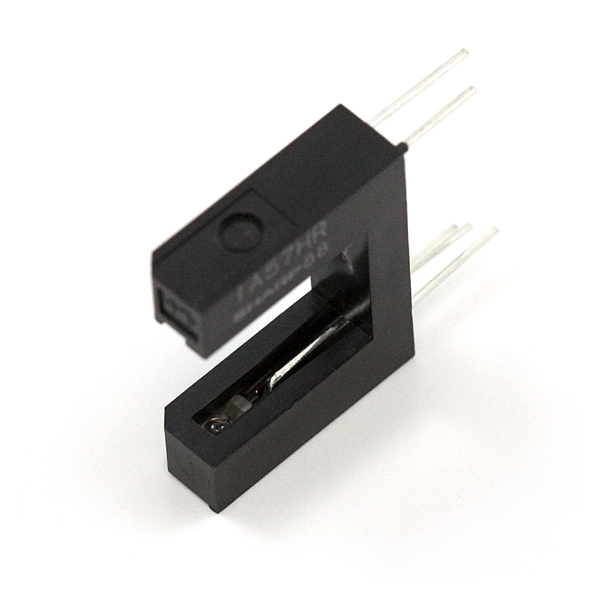
Our next task was to count the bees. As some related work had been done to make a feeder that counted the entries of bees and their stay durations using photogates; the initial thought was to use photogates (Fig. 3):
 |
Fig. 3: Photogate Sensor, not attached to circuit board [1]
|
A photogate works by sending a beam of light (not in our visible spectrum) to a sensor across from it. When something gets in between the beam of the light and the sensor, the sensor no longer has the light to detect and thus the output from the sensor changes. By putting two photogates, one after the next, we can tell if a bee is entering or exiting depending on which photogate was triggered first. Putting these sensors in an enclosure so that there is only enough space for one bee to walk through the sensors at a time and putting the sensor package at the hive entrance/exit we could get a reasonably accurate count of the number of bees entering and exiting the hive. As these sensors are made to be connected to an Arduino or something of the like, logging the data would be very doable.
After looking around online we found that others had already created systems to count bees. To list a few, this one uses an imaging system to count bees, another used capacitance sensors in tunnels but the one we settled on used infrared sensors and had a guide which we found appealing. Our initial design differed from the guide slightly, instead of using photogates the guide uses IR sensors. After some consideration we decided that we might as well go with the tried and true guide and perhaps try and improve it, instead of starting from scratch.
Using their model we could incorporate the hive weighing data as well. In the future we may add something called (oddly enough) an XBee, which would allow us to transmit the data wirelessly as well as log it to an SD card. As we move further along in this endeavor our next steps will be assembling the hardware, connecting it to a data logger, calibrating the sensors and testing the smart hive.
Further Reading:
Bee Counting Hive Instructable:
Load Cells:
Alternative Weighing Methods from Open Source Beehives:
Alternative Bee Traffic Counting Methods:
Chen, C., Yang, E. C., Jiang, J. A., & Lin, T. T. (2012). An imaging system for monitoring the in-and-out activity of honey bees. Computers and electronics in agriculture, 89, 100-109.
Chen, C., Yang, E. C., Jiang, J. A., & Lin, T. T. (2012). An imaging system for monitoring the in-and-out activity of honey bees. Computers and electronics in agriculture, 89, 100-109.
http://www.sciencedirect.com/science/article/pii/S0168169912002074
Campbell, J. M., Dahn, D. C., & Ryan, D. A. (2005). Capacitance-based sensor for monitoring bees passing through a tunnel. Measurement Science and Technology, 16(12), 2503.
http://iopscience.iop.org/0957-0233/16/12/015/
Media Credits:
[1] Image from Sparkfun: https://cdn.sparkfun.com//assets/parts/2/8/3/6/09299-3.jpg
No comments:
Post a Comment