During the first half of this semester, I was able to go to the Bernard Field Station to make natural history observations for my ecology class. The most interesting plant that I found was the wild cucumber, or
Marah macrocarpa. When I spotted the wild cucumber for the first time in mid-February, I had no experience in identifying vines yet! So, I referenced the
BFS plant photo key to help me look for distinguishing characteristics. Comparing the size and shape of the wild cucumber’s leaves to the descriptions in the photo key helped me identify the plant.
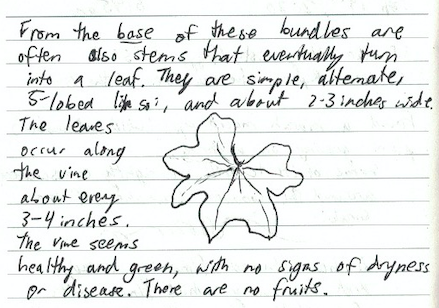 |
| [1] Notes from when I first encountered the wild cucumber in the BFS. |
When I got closer to the vine I found that it had these interesting small tendrils. At first, these tendrils seem delicate. But, they are actually strong enough to hoist the plant vertically as the wild cucumber grows by wrapping these tendrils to spiral around whatever plant it is climbing on. It was surprising to me how well the plant had wrapped around its host; it seemed to be securely attached.
The first time I saw the cucumber, it had a lot of little
white flowers but no fruit yet. But by the next week when I visited the field station, I spotted another wild cucumber that had spikey, ovalish fruits. I did not get to witness this, but the wild cucumber spreads its seeds when these pod-like fruits ripen and burst. The other thing that stuck out to me about the wild cucumber, besides its interesting fruits and tendrils, was the light, fuzzy hair that coated the stems of its vines. I noticed that a lot of other plants in the field station also had a similar type of fuzz. Since plants in the field station have to survive the desert sun, it made sense that these hairs were so common, as they help these plants survive this exposure.
 |
| [3] Two wild cucumber fruits from the same plant at Cistern Trail |
Due to the COVID-19 crisis that started this spring, I had to leave school in the middle of the semester. I thought that meant that I would no longer be able to get the chance to study the details of this plant because I couldn’t go to the field station anymore. Originally, I had planned to use the rest of the semester to study how the size of the host plant affects the growth of the wild cucumber. I thought this based on my observations in the field station where I noticed that the wild cucumbers were only growing in an area that had a lot of larger trees and shrubs.
I ended up staying in Southern California, the natural habitat of the wild cucumber. Before the pandemic closed trails in this area, I was able to go on some hikes that made me question my original hypothesis. Some of the wild cucumbers I saw were able to span several densely packed small bushes at once. Other wild cucumbers seemed to climb high into trees, and had their fruits dangling down vertically. But most surprising to me were some wild cucumbers that were growing on the ground; some tendrils had started to reach up at the stems of other small plants, but the majority of the vine was splayed out on the dirt. Interestingly enough, these cucumbers were still able to bear medium sized fruits.
Seeing the wild cucumber above ground led me to go home and do more research on the plant, which was when I learned about one of its amazing features. Above ground, the cucumber uses its tendrils to climb across shrubs and vertically up trees, but below ground, its massive root extends for meters. This massive
tuber holds water for the plant so that it can grow back quickly after a fire or the new season; it can end up weighing 200 pounds.
Taking time to notice and research the wild cucumber made me realize all interesting ways that the plant had adapted to its habitat. It was also exciting for me to read about the spiky fruits shortly after first identifying the plant, and then going out into the field station and seeing a fruit for the first time. It was fun to notice more and more details about the wild cucumber as I encountered more plants and spent more time observing it.
Media credits:
[1]: Scan of journal entry by Emily C.
[2]: Photo taken by Emily C.
[3]: Photo taken by Emily C.

Very interesting research on wild cucumber! It takes me right to the field of Southern California. I learned a lot about the adaptation of wild cucumber through your detailed note, pictures, and observations. Nice job!
ReplyDelete