 |
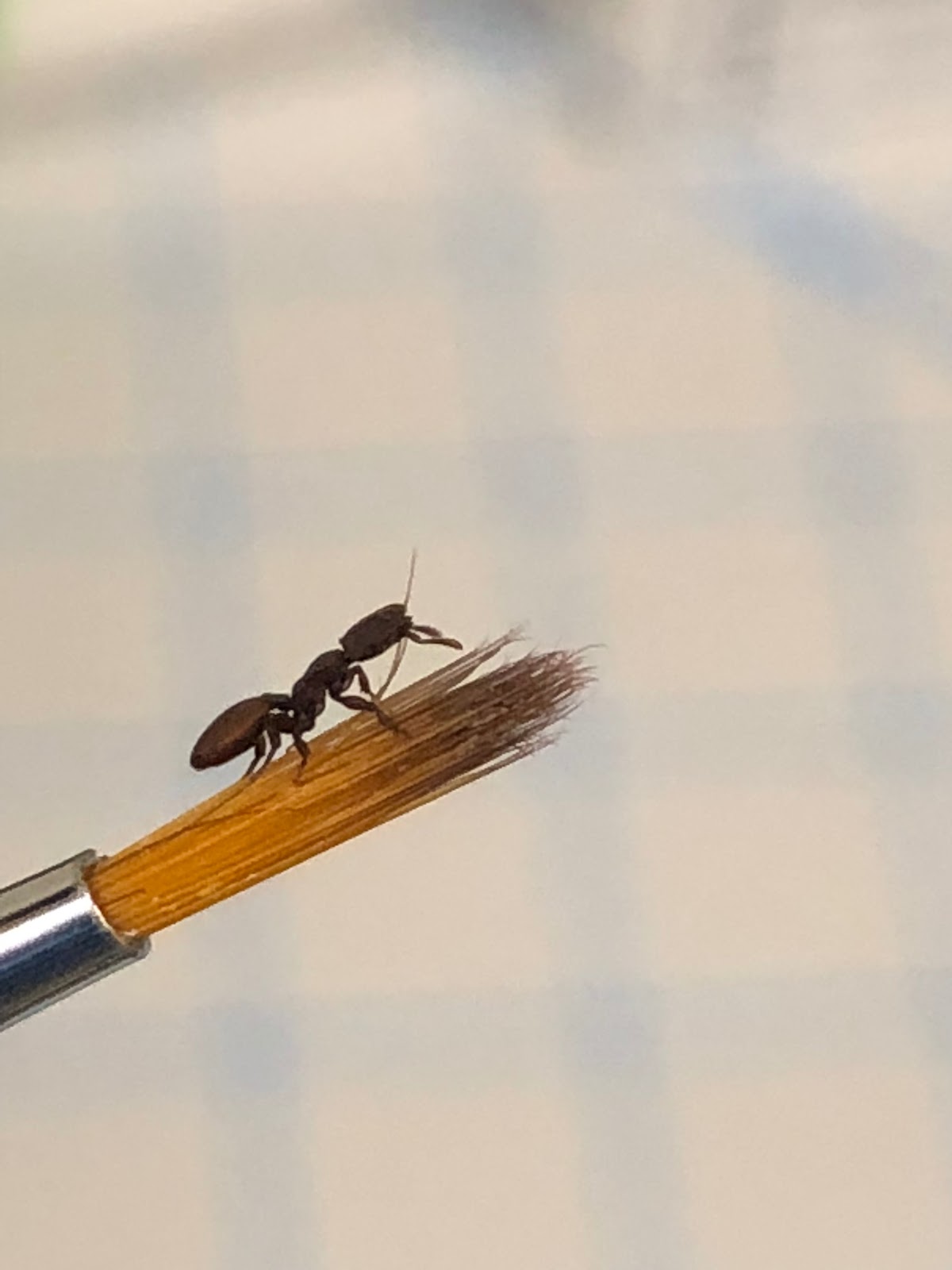
| One of our turtle ants biting a paint brush bristle. [1] |
No such luck. I was finally able to get the ant to stand on something instead of hugging the bristles with her body, but even then she refused to stop biting the brush. I tried gently coaxing the brush away from her, but instead of letting go of her bristle, she’d elect to just be dragged away by the brush. After a few minutes of failed attempts to wiggle the brush out of her bite, I realized I had lost my game of tug of war. Prof Donaldson came to the rescue with a pair of tweezers that were able to loosen the ant’s grip and finally get her to let go of the brush.
This made me curious: how was a worker ant able to get such a firm grip on the bristles? How else do ants make use of this strength? These questions have propelled me into learning about mandibles, the super strong multi-purpose jaws of ants.
There’s incredible diversity amongst ant species in both what mandibles look like and how they are used. Our turtle ants most often their jaws to lift or move objects, whereas carnivorous’ ants mandibles by necessity have developed to be more sharp and strong. However, certain species of ants have found more creative uses for their jaws. For example, trap-jaw ants in the genus Odontomachus sometimes use their jaws like a spring-loaded catapult to fling themselves out of harm’s way. In fact, Sheila Patek’s lab group at Duke University found that one specific species (Odontomachus bauri) is able to close its mandibles at speeds from 35 to 64 m/s!
 |  |  |  |
 |  |  |  |
Above is a selection of images displaying the variety in mandibles across species. The top row depicts ants from four different trap-jaw species. The bottom right ant is Cephalotes varians, the type of turtle ant we have in our lab. [2]
So how do these mandibles work? Most ant mandibles, like those of turtle ants, have a small mandible-opening muscle and a large mandible-closing muscle. However, as Fredrick Larabee and Andrew Suarez of the University of Illinois, Urbana-Champaign explain, trap jaw mandibles have a few additional components: a latch, spring, and trigger. The latch locks the jaws in their open position. When the ant uses its mandible-closing muscle, the potential energy builds up and is stored in the jaw’s spring. A trigger muscle releases the latch, causing the jaws to snap shut.These ants use their jaws as both a weapon and an escape mechanism. The rapid closure of the jaw can capture extremely fast prey, and when the ant aims its mandibles at a surface, it can propel itself through the air by use of the trap-jaw.
An Odontomachus bauri ant using its trap-jaw to launch itself. [3]
It’s incredible how ants have been able to develop these powerful spring-based jaws—but what if I told you that this type of mandible didn’t evolve just once? There are at least four different ant lineages (composed of a total of 21 subfamilies) that have independently evolved their own catapult-like mandible mechanisms. In this way, trap-jaw ants are not a specific branch of the ant evolutionary tree—instead, the term describes a group of morphologically diverse ant species with separately developed mandibles that all perform a similar function and display similar power and speed. As an example of just how varied these mandibles can be, all four of the ants pictured in the top row of ant images are different types of trap-jaw ants from each of the four lineages!
Although our turtle ants’ mandibles are tiny when compared to those of trap-jaw ants, they’re still impressively strong! It’s amazing to think how a student’s inconvenience with dealing with a stubborn ant is a product of this fascinating mechanism with a super interesting evolutionary history. I can now safely say I appreciate the beauty of the mechanism behind ant mandibles, even its strength does mean I’ll get caught up in a frustratingly hard-to-win game of tug of war every once in a while.
Further Reading:
Mandibles: Schmidt, C. A. 2004. “Morphological and Functional Diversity of Ant Mandibles.” Tree of Life Web Project. http://tolweb.org/treehouses/?treehouse_id=2482.
Trap-Jaw Ants: Patek, S. N., Baio, J. E., Fisher, B. L., & Suarez, A. V. 2006. “Multifunctionality and mechanical origins: ballistic jaw propulsion in trap-jaw ants.” Proceedings of the National Academy of Sciences, 103(34), 12787-12792. doi:10.1073/pnas.0604290103.
http://www.pnas.org/content/103/34/12787.
Evolution of the Trap-Jaw Mechanism: Larabee, F. J., & Suarez, A. V. 2014. “The evolution and functional morphology of trap-jaw ants (Hymenoptera: Formicidae).” Myrmecological News, 20, 25-36.
https://pdfs.semanticscholar.org/5289/bb427db0f1226b933ee1bfb658f6d86502db.pdf.
Media Credits:
- Photo by Nora Nickerson.
- Public Domain Images by AntWeb.org. (a) Microdaceton tanyspinosum, Photo by April Nobile, 2005. (b) Myrmoteras nicoletteae, Photo by Will Ericson, 2013. (c) Odontomachus haematodus, Photo by April Nobile, 2007. (d) Strumigenys paniaguae, Photo by Zach Lieberman, 2014. (e) Dorylus nigricans rubellus, Photo by April Nobile, 2007. (f) Eciton burchellii, Photo by Will Ericson, 2012. (g) Acanthostichus kirbyi, Photo by April Nobile, 2007. (h) Cephalotes varians, Photo by April Nobile, 2005.
- Video by the Patek Lab at Duke University, 2009. youtube.com/watch?v=-7b0YqQbUvU.
Who knew? Nice work!
ReplyDelete