Imagine if the next time you walked outside you saw a bear just sitting outside nearby. At first you would probably be scared and then somewhat concerned. You would probably decide that today was a good day to just stay inside. But what if it happened the next day as well? Eventually, if you saw the bear enough, just sitting outside your door minding its own business, you might even venture outside. If the bear still doesn’t do anything at this point you might ask yourself why you were so afraid of the bear in the first place, and eventually proceed to go about your usual business.
 |
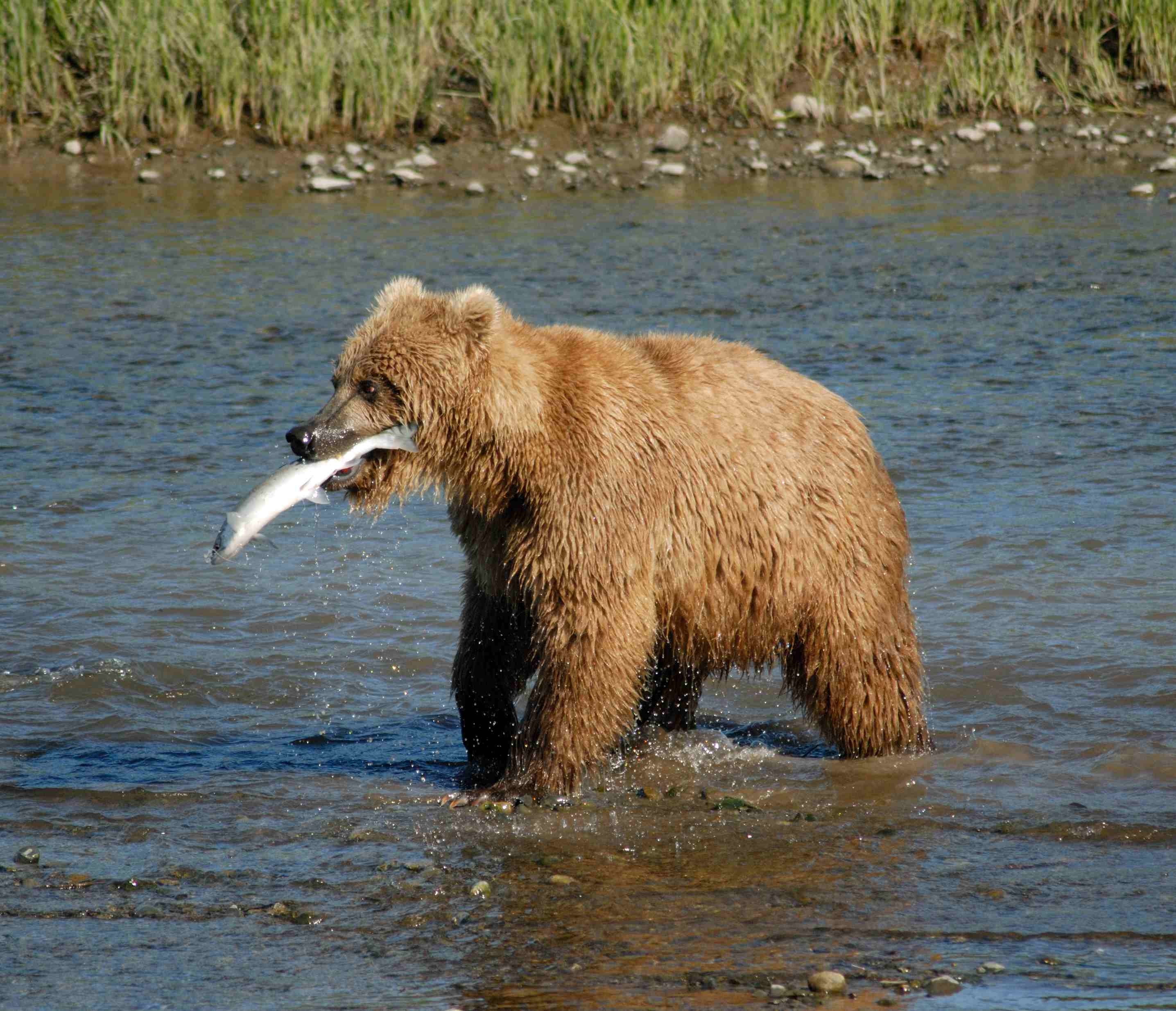
| A grizzly bear feeding on salmon in Alaska, photo by Carl Chapman [1] |
Now, take the bear and the person in this story and switch them. One would get a situation that becomes more and more common the more people venture into nature. The more interactions that people have with animals the more habituated the animals become to the people. Research done by Rachel E. Wheat and Christopher C. Wilmers [i] on bears in the Chilkoot Watershed shows that repeated non-confrontational interactions between bears and people reduces the fear based reactions of bears. This means bears that interact often with humans are then more likely to ignore people.
On the other side of the spectrum, bears that do not have many interactions with people will tend to avoid humans. These bears may shift their behavioral patterns to reduce the number of confrontations they have with humans. The same study [i] showed that though some bears become more habituated to humans, other bears respond by moving and being active when there are not many humans around. Of the bears in their study, those that were not habituated showed much more activity at night while those that were used to human activity were more active during the day. These activity cycles serve to reinforce the bears’ behaviors, with habituated bears becoming more used to humans and non-habituated bears not encountering many humans.
 |
| A bear looking for food in Yellowstone, photo by Jonathan Schilling [2] |
Changing activity times may not seem to make a huge difference, but habituated bears are the only ones hunting during the day when it is easier for them to see prey such as salmon [ii]. This also means that they also have less competition from other bears. As a result, habituated bears tend to have greater body mass and larger numbers of cubs per litter [iii]. This advantage given to habituated bears means that gradually, if nothing is done, more and more bears may become used to the presence of humans, as habituated bears have a better chance of reproduction.
With the increased popularity of tourism directed towards nature and wildlife [iv] one must think of the consequences of our interactions with nature and animals. Habituation of large predators such as bears has unintended consequences as well, with problems arising when bears move into more populated areas and become potentially dangerous nuisance animals [v]. These effects could potentially have long reaching effects on our interactions with animals, as it is impossible to prevent encounters between animals and people. We need to be mindful of how we affect the natural environment around us, even if it is just watching animals from afar.
References:
[i]: Wheat, Rachel E., and Christopher C. Wilmers. "Habituation Reverses Fear-based Ecological Effects in Brown Bears (Ursus Arctos)." Ecosphere 7, no. 7 (2016) DOI: 10.1002/ecs2.1408
[ii]: Crupi, A. P. 2003. Foraging behavior and habitat use patterns of brown bears (Ursus arctos) in relation to human activity and salmon abundance on a coastal Alaskan salmon stream. Graduate Theses and Dissertations, Paper 4777. Utah State University, Logan, Utah, USA. http://digitalcommons.usu.edu/etd/4777/
[iii]: Hilderbrand, G. V., C. C. Schwartz, C. T. Robbins, M. E. Jacoby, T. A. Hanley, S. M. Arthur, and C. Servheen. 1999. The importance of meat, particularly salmon, to body size, population productivity, and conservation of North American brown bears. Canadian Journal of Zoology 77:132–138. DOI: 10.1139/z98-195
[iv]: Knight, J. 2009. Making wildlife viewable: habituation and attraction. Society and Animals 17:167–184. DOI: 10.1163/156853009X418091
[v]: Kirby, Rebecca, Mathew W. Alldredge, and Jonathan N. Pauli. "The Diet of Black Bears Tracks the Human Footprint across a Rapidly Developing Landscape." Biological Conservation 200 (2016): 51-59. DOI: 10.1016/j.biocon.2016.05.012
Media Credits:
[1]: Photo by Carl Chapman https://upload.wikimedia.org/wikipedia/commons/4/46/Bear_Alaska_%283%29.jpg
[2]: Photo by Jonathan Schilling https://upload.wikimedia.org/wikipedia/commons/2/29/Bear_approaching_vehicle_in_Yellowstone_National_Park_1967.jpg

An interesting application of operant conditioning theory - if the presentation of a stimulus (human) precedes a neutral consequence, the stimulus becomes desensitized to the subject (bear). With the pressures presented by human expansion, the two species coexisting peacefully and ignoring each other would definitely be an ideal situation. However, I don't know how practical this is to bank on. First, it only takes one very negative interaction, such as a human in between a bear and her cubs, to tarnish the neutral association and make the animal more likely to be aggressive towards humans in the future. On the other side, if the bears act "gentle" or unafraid of humans, people may be more inclined to try to feed them, which creates animals that are dependent on humans as a source of food and may become aggressive in an attempt to eat more.
ReplyDeleteI agree that it really only takes one bad interaction between bears and humans to ruin the relationship, but I think the main risk is on the part of the bears. There are many situations where bears and other animals have been killed after repeatedly getting too close to people. I do think though that the second conclusion of Rachel Wheat and Christopher Wilmers, which is that some bears not acclimated to humans actually avoid them by changing to a more nocturnal lifestyle, is as important as how other bears acclimate to humans. This is because these "skittish" bears will actually reduce total interactions with humans.
DeleteHmm, it's interesting to think about what other bear "personality" traits might go along with that differential response to humans....
Delete