 |
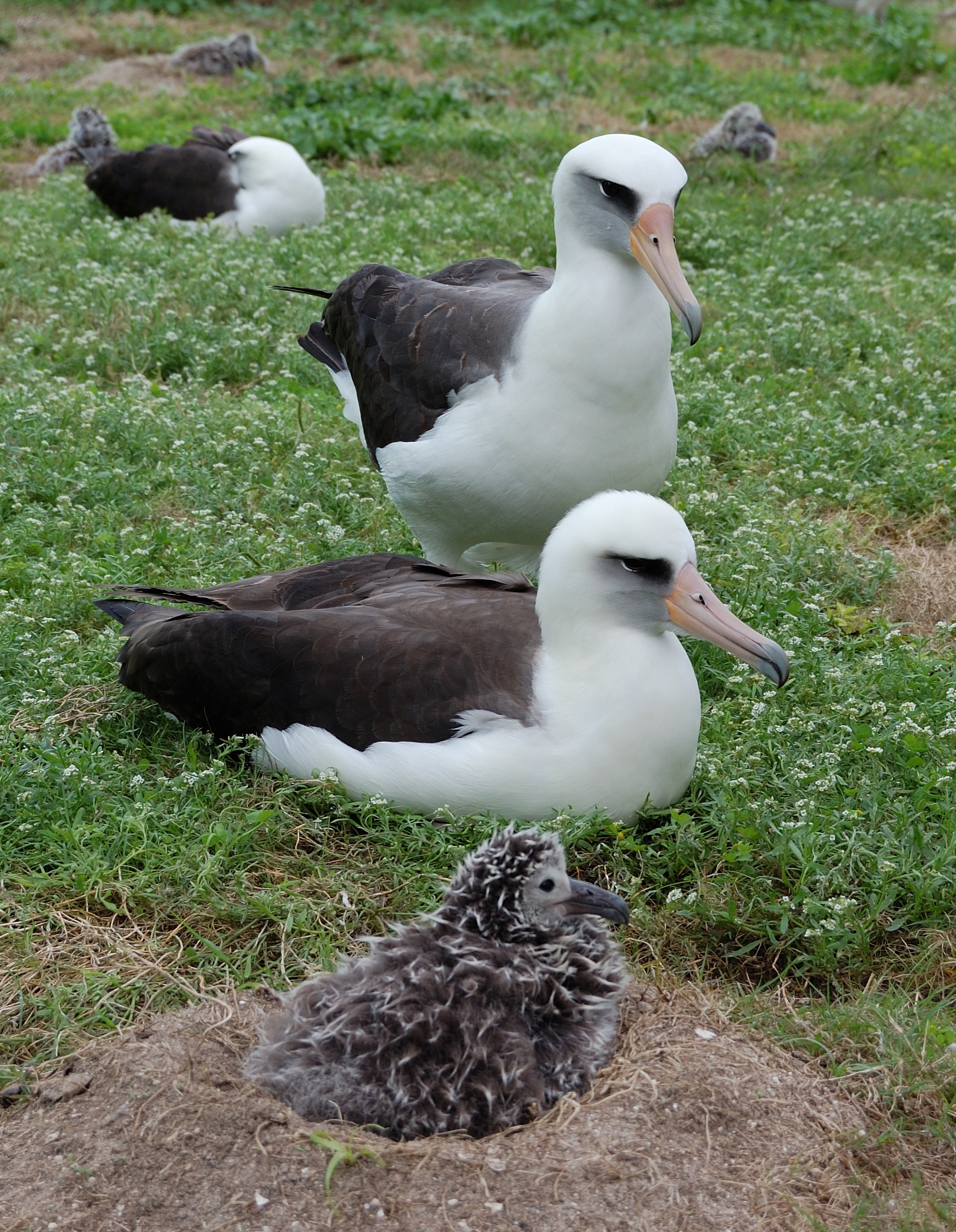
| [1] An example of a Laysan albatross pair, and their nest and chick. |
It’s kind of like when two high school girls go to prom together because they couldn’t find dates – after all, going to prom with your best girl friend is more fun than not going to prom at all. Just like human teenagers looking for prom dates, some female albatrosses choose to enter a same-sex pair rather than not pair at all. Since pairing is required in order to incubate a single egg, perhaps forming same-sex pairs confers some advantage to these female birds, allowing them to have offspring when they otherwise would be childless.
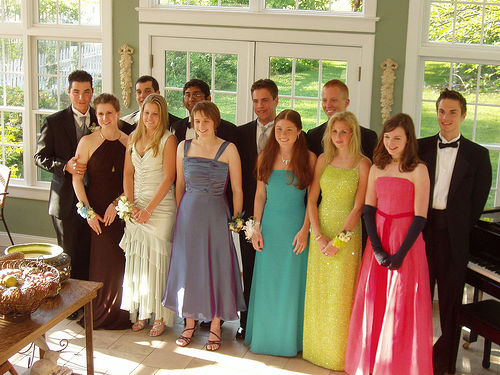 |
| [2] While the lucky students in this photo were are able to find dates to the prom, often fewer male students are interested in dancing. This skews the sex ratio and causes many female students to attend the dance with their girl friends. |
The researchers found that nearly one-third of all paired birds were female-female pairs. These pairings could last for multiple mating seasons, and both females in the pair had chances to lay the egg each year. Since pairing up with another female sometimes allowed the female birds to have offspring, it was a better strategy than not mating at all. (Although it was still far less successful than if they were in a male-female pair, especially since the females had to take turns laying the egg each year, reducing their number of biological offspring by 50%.)
However, a surprising result was that there were some unpaired males in the colony. Sometimes, even when a male is available to pair, he doesn’t pair with a female who has been in a female-female pair the year before. This is especially true if the female-female pair did not produce a chick. This suggests that the male albatrosses may be choosing which females to pair with based on how successful those females had been the previous year. This is a form of sexual selection, and it’s interesting because usually males are the ones competing for female choice, but in the albatross population, the females must compete for male choice.
Another piece of evidence that sexual selection is happening is, that for the female-female pairs, if they successfully incubated the egg together in the first year, then on average 4% of them could gain a male partner the following year. But if a female-female pair failed to incubate their egg in the first year, then their chances of finding a male partner the next year were basically 0.
 |
| [3] A figure from the publication that shows the likelihood that a female albatross will transition between male-female and female-female pairings. A successful MF pair (had an offspring) is likely to stay together, and a successful FF pair is likely to gain a male partner the next year. But unsuccessful females are likely to end up being stuck with a female partner the next year. |
Conversely, if a female already has a male partner, she skips breeding less often, even when skipping might provide a health advantage. Why? Well, a female with a male partner who skips breeding is more likely to lose her partner the following year, so there is pressure on the females with in male-female pairings to keep breeding, no matter the physical cost. This sexual selection by male albatrosses on the females could be making the females breed more often, as they try to reserve their status as a high-quality female.
The story of the Laysan albatrosses shows that an imbalance in the sex ratio can lead to an unusual instance of sexual selection - where the females must compete for the attention of males, instead of the other way around. This kind of sexual selection can then cause radical behavior changes in the population, in a span of only a decade!
Journal Citation:
Young, L. C. and VanderWerf, E. A. 2014. Adaptive value of same-sex pairing in Laysan albatross. Proc R. Soc. B 281: 20132473. URLS: http://dx.doi.org/10.1098/rspb.2013.2473 and http://rspb.royalsocietypublishing.org/content/281/1775/20132473
Media credits:
[1] James Lloyd, Laysan pair and chick. Wikimedia Commons upload, March 2008. CC-BY-SA-3.0; Released under the GNU Free Documentation License. http://en.wikipedia.org/wiki/Laysan_albatross#mediaviewer/File:Laysan_pair_and_chick.jpg

[2] Ken Stokes, Preprom. Wikimedia Commons upload, May 2005. Released under the GNU Free Documentation License. http://commons.wikimedia.org/wiki/File:Preprom.jpg

[3] Young, L. C. and VanderWerf, E. A. 2014. Adaptive value of same-sex pairing in Laysan albatross. Proc R. Soc. B 281: 20132473. URLS: http://dx.doi.org/10.1098/rspb.2013.2473 and http://rspb.royalsocietypublishing.org/content/281/1775/20132473
It sounds like the most desirable female albatross are having much higher reproductive success than the less desirable females. I wonder if the next generation of female albatross will be particularly attractive to males.
ReplyDeleteAlternatively, if albatross can dictate the sex of their offspring, the next generation of albatross on Oahu may be heavily male, swinging the pendulum the other way.
Like Elsie, I wonder what the long term effects of this will be. We're getting male-chooses-female sexual selection, so the next generation may be particularly attractive. However, if Albatross produce a 50:50 sex ratio normally, then there's only one generation's effect which is not long in evolutionary time.
ReplyDeleteI liked the prom metaphor. It was funny.
I wonder how long the gender imbalance will last. Will it persist because not breeding yearly is healthier for females? Alternatively, is there some survival advantage besides offspring for male-female pairs that will pull the gender balance back towards an equilibrium?
ReplyDeleteThanks for this interesting blog post! Do same-sex pairings occur in Laysan albatross populations with balanced sex ratios? If they do, I wonder if the female-female pairs or the unpaired males arise first in the population.
ReplyDeleteThanks for the comments everyone! I can actually answer a couple of the questions. Kevin, the gender imbalance will probably even out after a few generations, but since the albatrosses live for a very long time, take many years to mature and reproduce, and have only one offspring per year, I think the effects will still be noticeable for quite a while, maybe decades. And Mieke, same-sex pairings have not been observed in the other, more balanced populations of albatross. (But the researchers hypothesized that, because the albatross mate for life and have low transition rates, that even when gender ratios are more even, same-sex pairing may persist longer than is needed in this population.)
ReplyDelete